M-Twin4US
Maintenance-oriented Digital Twin for Underground Infrastructure
About the Project
Underground utilities and tunnels are critical to modern cities, yet their condition is largely hidden from view. Maintenance decisions are often made with sparse, indirect and uncertain information about what lies beneath the surface.
M-Twin4US is a Marie Skłodowska-Curie Postdoctoral Fellowship developing a maintenance-oriented digital twin framework (M-Twin) for buried infrastructure. The project combines non-destructive sensing methods such as ground-penetrating radar (GPR), AI-assisted diagnosis, multi-physics simulation and uncertainty quantification to turn subsurface measurements into decision-ready information for the maintenance of underground utilities.
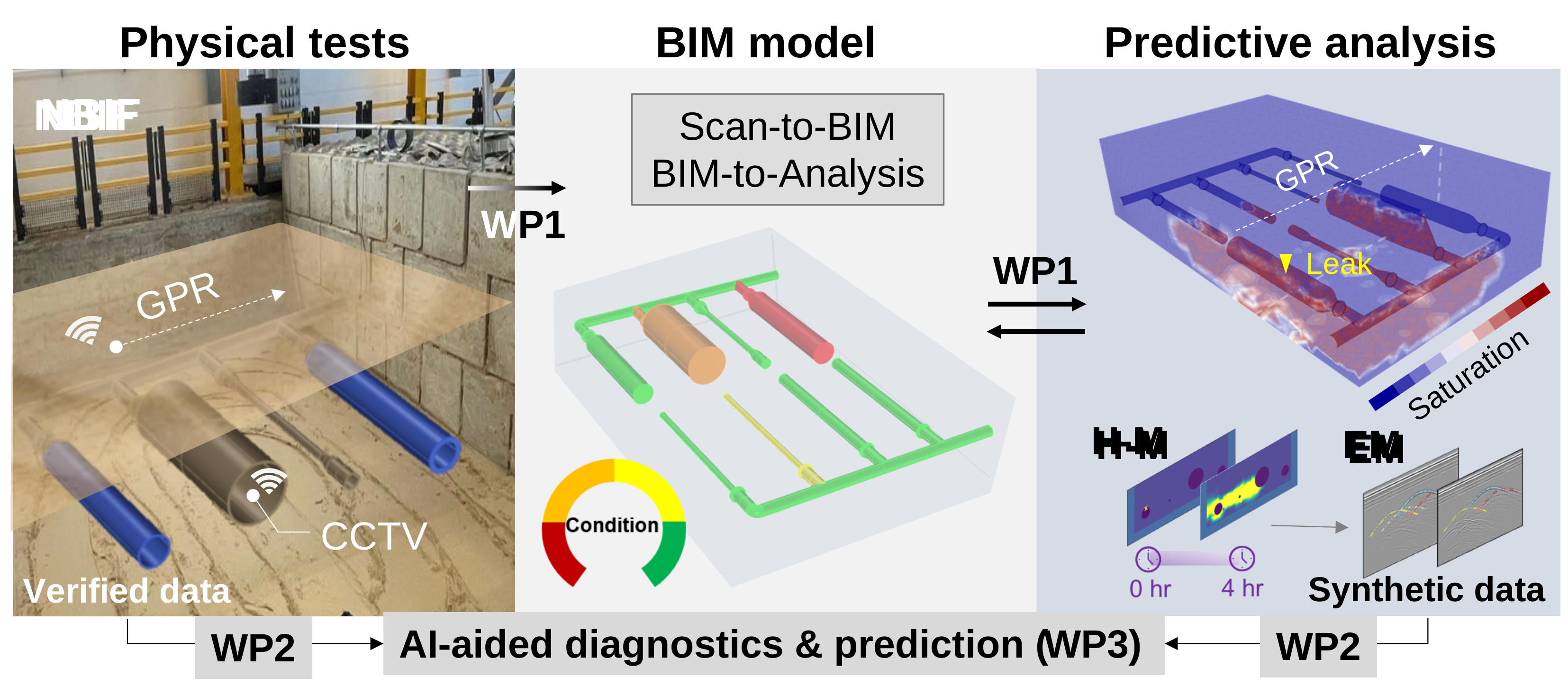
Research Approach
GPR Sensing & Simulation
Ground-penetrating radar as the non-destructive sensing layer of the twin, supported by physics-based and surrogate GPR simulation.
Uncertainty-aware data interpretation & UQ
Inferring subsurface conditions from sensing data while quantifying how certain—or uncertain—those estimates are.
Maintenance Decisions
Linking the digital twin to maintenance-oriented decision-making for underground utilities and tunnels.
Latest Publications
-
DOWSER: A DINO-based One-shot Water Seepage Recognition network for TBM tunnel inspection
Tunnelling and Underground Space Technology, 2026
-
Automating dense GPR simulations for C-scan imaging of subsurface infrastructure
Automation in Construction, 2026
Contact
For questions or collaboration enquiries about M-Twin4US, connect with the fellow on LinkedIn.